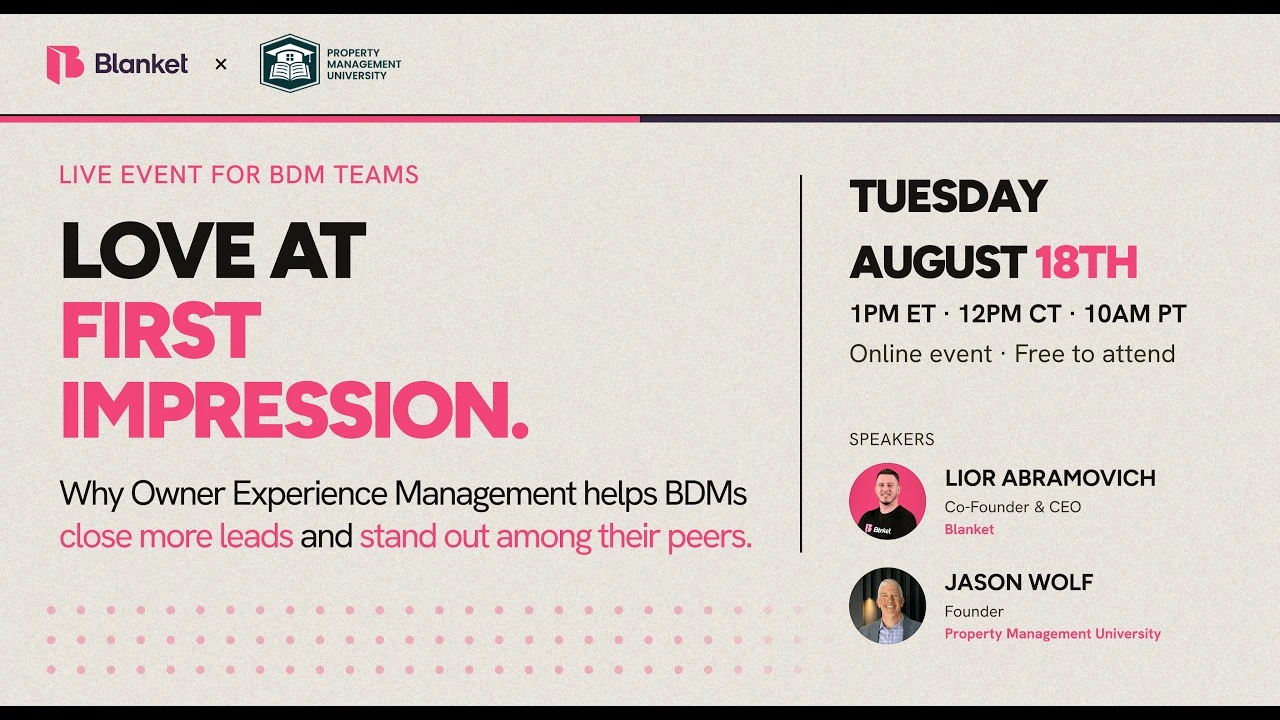


The first-30-days motion is the run of onboarding touchpoints - from a signed property management agreement through the first maintenance request - that decides whether a new owner turns into a long-term client or churns within the year. Business development managers lose more deals in the first qualification call than most teams realize, and “Love at First Impression” is a replay built specifically for business development, covering the messaging, discovery, and closing habits that decide whether a lead becomes a signed owner - and whether that owner stays.
Watch the replay
Edited and verified by Lior Abramovich, September 2026.
Lior Abramovich, Blanket’s co-founder and CEO, presented this session with Jason Wolf, founder of Property Management University.
The four sections, and what each one covers
- Channel playbooks. Different owner types respond to different messaging. The session breaks out playbooks for three personas - intentional investors, unintentional investors, and accidental landlords - so outreach matches who’s actually on the other end.
- The discovery gap. Discovery calls leak revenue when a BDM treats every prospect the same. The replay walks through how to spot which of the three owner personas is on the call, early, so the rest of the conversation can adjust.
- Persona-specific closes. Once the persona is identified, the message, cadence, and close that works for an intentional investor is not the one that works for an accidental landlord. The session lays out what changes and why.
- The second sale. Winning the first deal isn’t the finish line. This section covers how business development carries the relationship into an expansion motion - brokerage, referrals, and portfolio growth from an existing client - rather than handing it off and starting over on the next lead.
Why the first 30 days matter
The session’s throughline is that OEM (Owner Experience Management) doesn’t start after the deal closes - it starts in the first impression. A BDM who reads the wrong persona in a discovery call sets up a relationship that a property manager then has to repair for months. Getting the read right in week one changes how much of that relationship survives.
The cost of treating every lead the same
A generic discovery call - “tell me about your property” - works fine on paper and loses deals in practice, because an intentional investor evaluating three property management companies wants numbers and a fast decision, while an accidental landlord who just inherited a house wants reassurance and a slower pace. Pitch both the same way and one of them checks out of the call. The replay’s persona work exists to catch that difference in the first few minutes, before the rest of the conversation runs on the wrong assumptions.
That’s also why the second-sale section matters as much as the close itself: a BDM who reads a persona correctly at signing has a much easier time, months later, spotting when that same owner is ready to add a second property or refer a friend - the read doesn’t expire at the signature.
Who this is for
Business development managers and BDM team leads who want a repeatable playbook for the first 30 days of an owner relationship, not just a general pitch on closing more deals.
Go deeper
The Owner Experience Management Certification referenced in the replay is run through PM University, independent of Blanket. For how Blanket helps business development teams move faster from lead to signed PMA, see Super BDM.