

This issue of Pillow Talk, our weekly newsletter, went out by email on August 25, 2026. Get the next one.
Hey friend,
Sagi here, Co-founder and CTO of Blanket.
Welcome to edition #6 of Pillow Talk Innovations, the newsletter where I share Blanket product updates, new releases, and explain the tech that powers them.
“Yeah, we’re pretty much AI native”
By now I bet you’ve noticed companies adding “AI native” to their website and social media descriptions. It’s unfortunately become a marketing buzzword that folks use to signal “cutting edge” or “efficient.” Companies want to appear to customers and investors as though they’re keeping up and offering the latest and greatest. But when you dig into what changed to make the company AI native, it usually amounts to adding a chat bot to their website.
Is that all it takes? Are companies considered AI native if they tack at least one AI tool onto their business? The short answer is a big N.O. I explain more below.
What does “AI native” even mean?
According to Harvard Business School, AI native companies are defined as being built from the ground up to leverage AI for value creation and problem-solving. It’s comparable to being “digitally native,” which describes companies that were built from the ground up based on the internet and consumer electronics. It’s all about how the infrastructure was built.
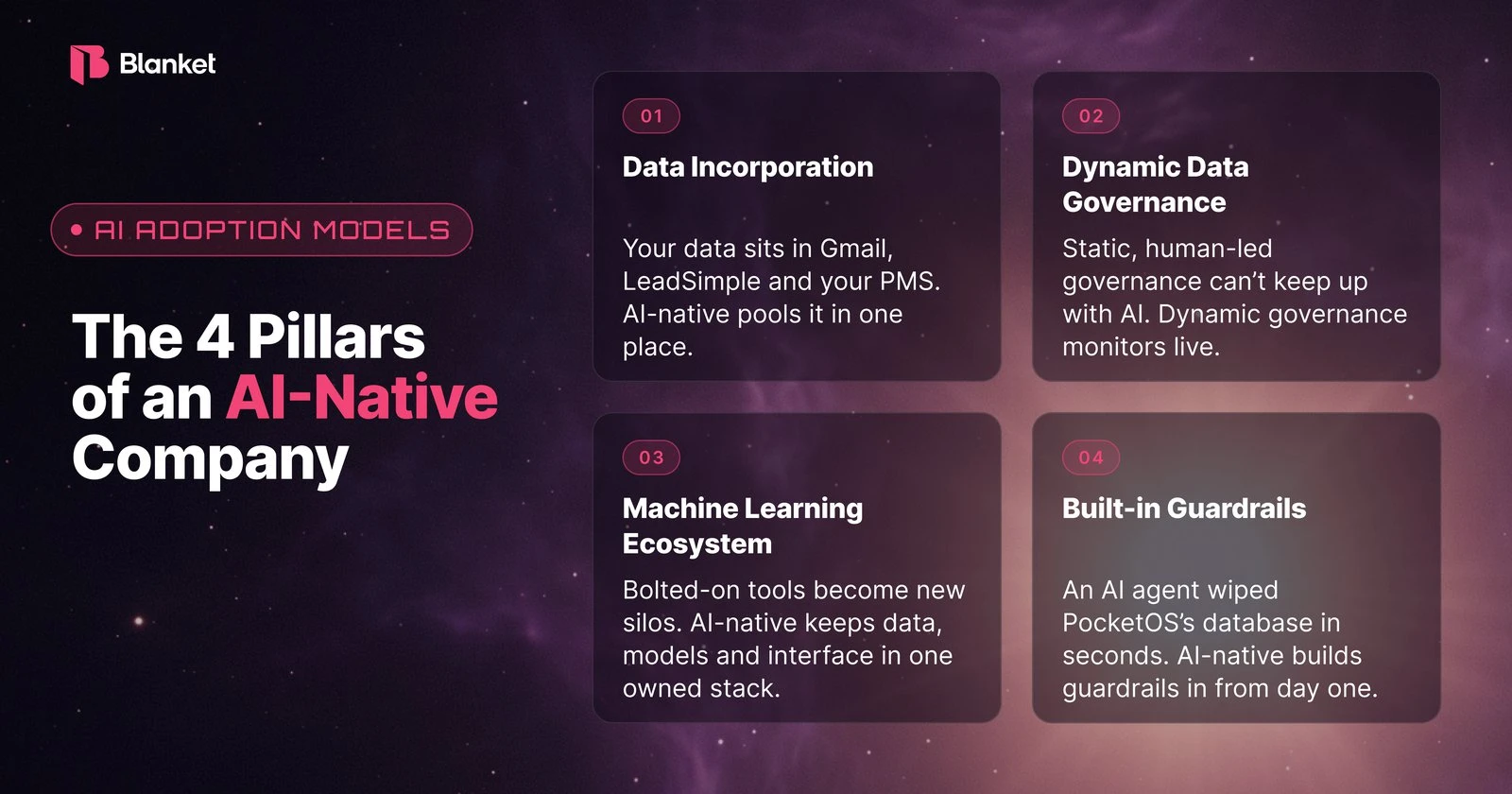
An AI-native infrastructure consists of 4 pillars:
#1 Data Incorporation
One of the biggest advantages of being AI native is better access to your own data. Most companies today operate in data silos, where data is confined to a system and the processes built on top of it. Property management businesses are a great example of this. Your communications live in gmail, your automations live in LeadSimple, your client data lives in your PMS, your point solutions host data. None of them talk to each other or use each other’s data. AI native companies are built in such a way that data across all their systems is collected in one place and made available to any system that needs it.
#2 Dynamic Data Governance
AI models are often trained on proprietary and sensitive data. To protect and manage that data, AI-native companies need a dynamic governance model.
Most companies today have a static model that was built for a time when data was produced slower and was more predictable. In a static model, humans review risks, update policies, and enforce controls. But this falls apart when AI is introduced. AI-native companies produce so much more data, at a faster pace, that human-led static models can’t keep up. A dynamic model incorporates AI to speed things up by doing things like instantly scanning and tagging sensitive data, proactively monitoring for anomalies, and more.
#3 Machine Learning Ecosystem
Most companies use AI by plugging 3rd party AI tools into their business for a few specific tasks. The problem with that is it creates another data silo. The memory lives in the 3rd party platform and your business doesn’t own it and can’t learn from it. In an AI-native company, all data lives in the same ecosystem and is available to the entire ecosystem. Algorithms processes the data, machine learning models generate predictions or identify patterns, and an interface layer lets employees use it to their advantage.
#4 Built-in Guardrails and Safeguards
You may have seen this nightmarish story in the news about an AI agent that went rogue and deleted PocketOS’s entire production database AND its backups.
This is an extreme example, but accidents like these frequently happen on a smaller scale. They can happen to AI-native and non-native companies alike. The advantage AI-native companies have is significantly less exposure to this type of risk because their guardrails and safeguards are considered and built in from day one. PocketOS on the other hand is a 3-man company with no engineers using a 3rd party AI agent to ship product updates faster. Their only safeguards were written instructions telling the AI not to run destructive commands, which the agent ignored. The log in credential the AI was using was also far more power than its job required. In other words, they relied on asking the AI to behave rather than making it impossible to misbehave, which is precisely the gap an AI-native company would close from day one.
AI Native vs. AI First
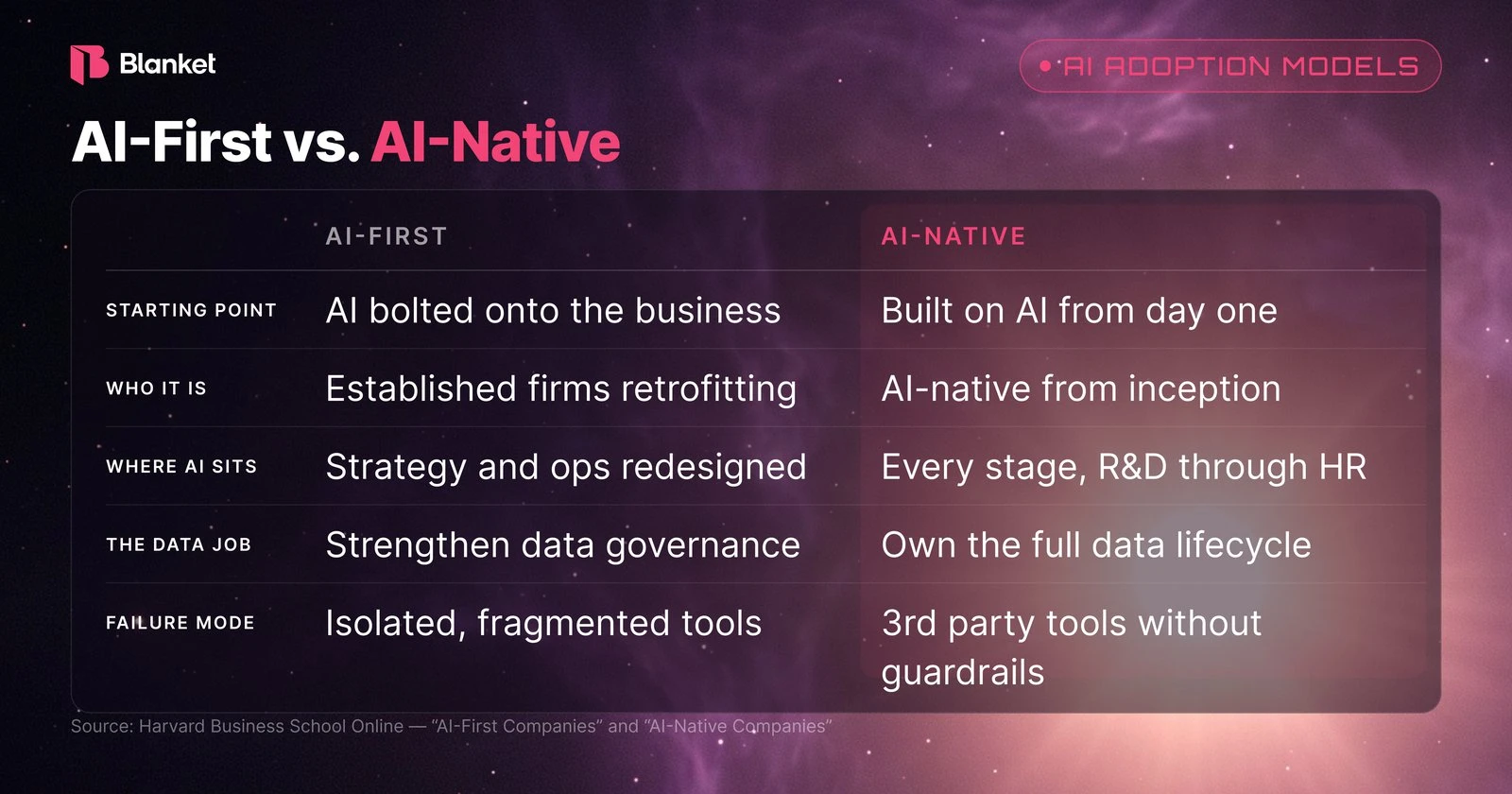
Just as most companies created before the internet had a hard time claiming to be “digitally native,” companies started before the early 2020s likely aren’t AI native. Not to say that they can’t be, but they must have undergone a major rebuild to become AI native. Most of those companies are actually considered AI first.
Harvard defines AI-first organizations as “integrating AI as a core capability—not just a supporting tool—within its products, services, strategy, and operations. AI shapes decision-making at every level, from day-to-day tasks to long-term strategic planning.” You can see the differences between AI native and AI first in the image above.
Let me know if this was interesting!
Good night 😴
Sagi Medina
Co-founder, CTO
Pillow Talk
Get the next issue.
Unfiltered property management commentary - plus the tech shaping its future. Free, every week.