

This issue of Pillow Talk, our weekly newsletter, went out by email on May 28, 2026. Get the next one.Editor's note, October 2026: This issue describes Blanket as it was when it was sent. Product names, packages and features have changed since, and some work differently today.
Hey friend,
Welcome to the 41st weekly edition of Pillow Talk! This is where I share my unfiltered thoughts on life, business, and property management.
This week, we’re setting the record straight on asset management for property managers.
For a long time, whenever I spoke to a group of property managers at a conference or networking event, I would always see eyes glaze over as soon as I brought up asset management.
I thought maybe I was presenting the information poorly and confusing people, or that I was talking about it in a boring way and needed to find new tricks to spice up my presentations. I knew I was missing something.
Eventually, I learned the problem was a nuance in the definition of asset management that I wasn’t explaining. In this newsletter, I’ll tell you what the nuance is, and what it means for property managers.
Two Types of Asset Management
The most common type of asset management deals with fractional ownership. This is when a group of people each own a small piece of the same property. In this type of arrangement, a sponsor puts the deal together (like buying an apartment complex) and a group of investors put up most of the money. The asset manager works for the sponsor and is in charge of making the property succeed for everyone involved. Their main job is executing the business plan that was promised to investors. They don’t collect rent or fix leaky sinks themselves. Instead, they hire and oversee a property management company that handles the day-to-day work.
This is NOT the type of asset management I’m referring to when I talk about it online or at conferences, but it’s what the audience assumes I mean. Eyes used to glaze over during my talks because they didn’t think it applied to them.
What does apply to property managers is asset management in the context of direct ownership. Direct ownership describes the vast majority of the single-family and small multifamily rental markets. One person or one company owns the whole property by themselves. They get all the rent, all the profit when it sells, and all the risk if something goes wrong. They can move fast and do things their own way, but they also have to put up all the money and handle all the problems.
In a directly owned single-family rental portfolio, the owner is traditionally the asset manager too. They manage all the forward planning of the property and set the strategy. When rates drop, they decide whether to refinance. When the market is hot, they decide whether to sell. The whole job is making smart, long-term decisions.
The Problem and the Opportunity
The problem with owners being their own asset manager is that the vast majority of them are unequipped for the job.
98% of single-family rentals are owned by mom-and-pop landlords with 1-5 properties. Most have low financial acumen and little-to-no real estate experience, and wouldn’t know the first thing about setting a rental strategy. Yet, these owners are making financial decisions that impact the largest asset they’ll likely ever own without the guidance of a professional. And that’s where property managers have a huge opportunity. In fact, the 2026 PM Trends Report found that 51% of respondents are willing to pay their property manager extra for asset management services.
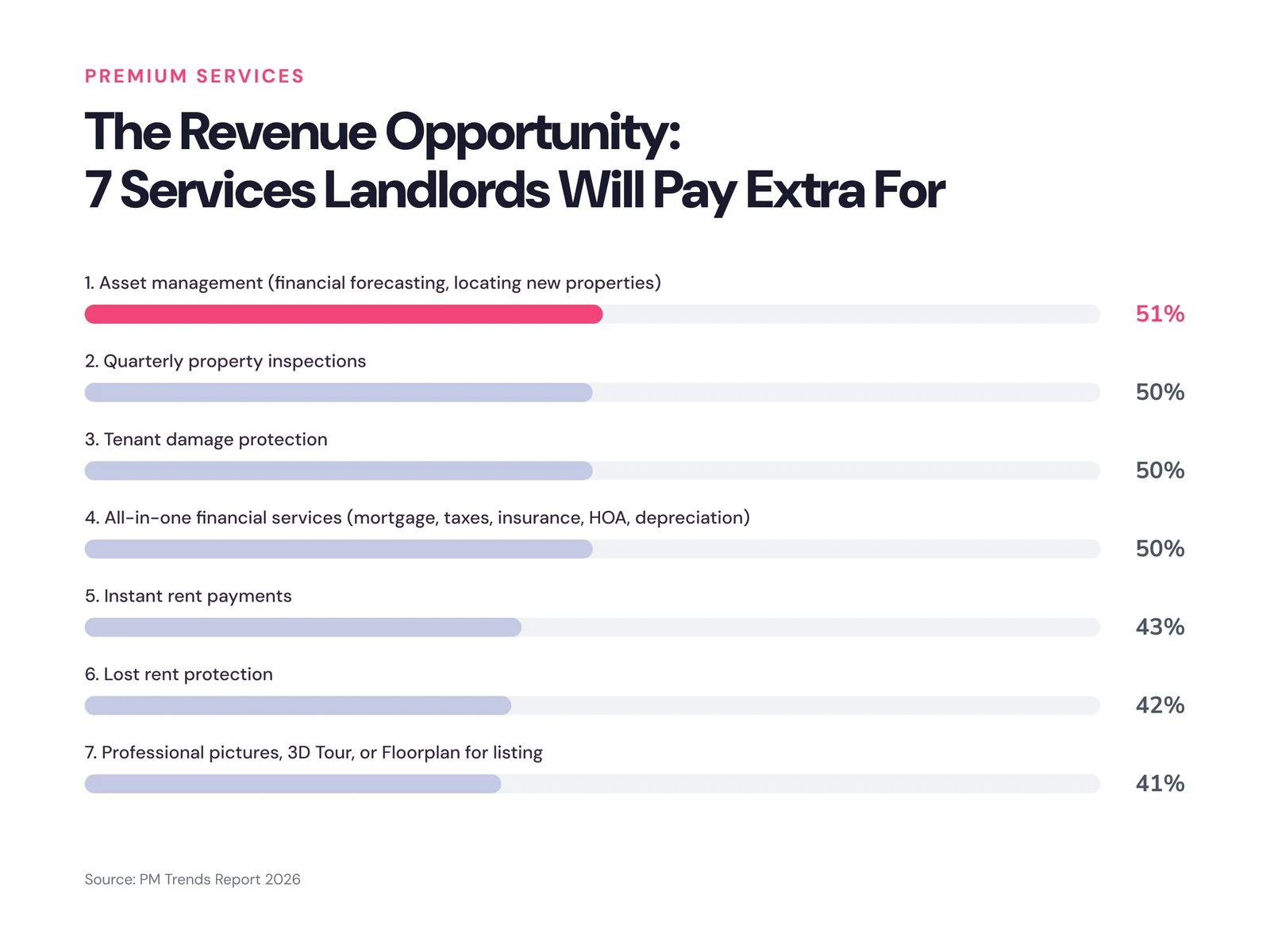
This goes to show that owners want and need the long-term help of someone who understands the asset class, and can help them improve income, protect downside risk, grow equity, and make better hold, renovate, refinance, buy, or sell decisions over time.
*No one is better positioned to step into this gap than property managers.*
How PMs Can Capitalize
The problem with offering asset management services to SFR owners is the same problem scattered site property management has always had: It’s tough to scale.
Asset management requires personalized reporting and planning across every property. Large multifamily asset managers might have dozens of investors they report to, but they’re only preparing reports on one property. In a direct ownership context, you might have to prepare reports for dozens of clients on dozens of properties. The lift is much heavier. This is exactly why most PMs don’t send annual owner letters. It’s just too much work.
Because of the scale problem, property managers have used asset management as a nice value-add to help retain high-value clients, not to generate revenue. But thanks to technology and the things we’re building at Blanket, asset management can now be executed across your entire management portfolio. Now, reporting can be prepared for every client and every property in minutes rather than hours. Investment analysis used to plan for the future of the property are now near-instantaneous. Research for hold, renovate, refinance, buy, or sell recommendations is completely automated.
Before, it didn’t make sense to monetize asset management because it was only done ad-hoc for a few special clients. But now, it can be packaged up and sold to all of your owner-clients. And depending on how your company is set up, it can drive even more revenue by bringing business to your brokerage.
Good night 😴
Lior Abramovich
Co-founder, CEO
Pillow Talk
Get the next issue.
Unfiltered property management commentary - plus the tech shaping its future. Free, every week.